Wednesday, February 8, 2012

I want more FB, you now have an IPO

FB, you promised me connectivity

With friends and things of myriad variety.


A platform virtual you gave to me

To tell the world what I like, look and see.


I wake to logon, log-off to sleep

You are my virtual diary I share and keep.


What I shared had value because of me

It wasn’t data or information; ne’er a possibility.


But now it seems there is value to my voice

An FB IPO of $ 5 billion; ain’t that nice?


Ad’tisers, mark’ters can now hit me with their product

On FB I have become a sitting duck.


What I say, share and post

Has now come to haunt me like a Dickensian ghost.


FB like Christ has turned water into wine

Let FB users partake in this feast divine.


If FB gains from my info and time

Shouldn’t FB pay to use what is mine?

Saturday, February 4, 2012

Leave them kids alone

Kids are cute, kids are nice
Kids are anything that advertisers wish to symbolise.

Kids are cheap, kids are many
Kids act out anything from serious to funny.

Kids are innocent. Some parents a tad greedy?
Put their kids in adverts which are morally seedy.

You ain't doing enough kids tell their ma and pa
Just so that companies can rake in the moolah.

For the company it is not always about da money
It's about looking good in front of many.

Take for example two companies that mine
Who use kids to burnish their shine.

Well known for their exploits; one in sugared drinks da other in bauxite
These co's use kids to divert from what they exploit.

Urban kids singing peace, rural kids learning
What pay's for these ads looses it's meaning.

And so through the TV another world is created
Leaving demands for justice, environment, health unsatiated

How is it that something so small and innocent,
Manufacture's hope for the one percent?

Monday, January 23, 2012

And in Jaipur - - - - - -

And in Jaipur, where the fest is lit

Talk was about an Indian who is a Brit

He wrote a book, much unseen and unread

Resulted in a price on his head.


And in India where this book is banned

It raised the hackles of the 'Deoband'

They posed a question which was a shocker

If the book is banned why aint the author?


So this guy in Jaipur did not appear

Instead, few brave hearts read excerpts without a fear

When the inviting rooms of Indian prisons were promised as their due

They claimed ignorance of laws and fled without an adieu.


The chap who made mediocrity a household ambition

Spouted his views with élan and gumption

Those who hurt sentiments, shouldn’t be heroes made

As this is the manner they will get repaid.


‘Who is a liberal?’ is the question being written and spread

For certain, it is the green and saffron who tell us what should be seen and read

Unsure of the past and insecure of the future we seem to be

A different view be damned, all hail to conformity.

And mediocrity.

Monday, November 28, 2011

Turn the other cheek?

When there is no money to buy another pair of shoes

Is it any wonder that the hand was used?


But what caused the hand to meet the cheek?

Is the current scenario indeed so bleak?


We have Mukesh Ambani not entering Antilla

But says that faster reforms should be high on the agenda.


We have a government unable to help agriculture

But thinks FDI in retail will help this sector.


There is a parliament that frequently convenes

Where members raise salaries, voices and let out steam.


And while those who can feast fast for a cause

There are hapless millions going hungry without pause


Though some say a slap and violence we must eschew

Could it be communicating the common-man’s point of view?

Tuesday, November 22, 2011

Rewriting legal redressal and history

Jayanti Natrajan , from the Congress fold
Is now hot property but then was cold.
What she did as our new environment minister
Would have been smart, if it had come from a school teacher.

The story goes like this the papers say
HCC built an eco-city and so hills were done away
It was easy to see that environmental norms were flouted
What about the tribal? others shouted.

Lavasa's construction came to a grinding halt
Twas no doubt that the HCC was at fault.
So, then began the company's cry of wasted investment
All forgot about the area’s natural and beautiful raiment

Then Jayanti Natrajan; like a knight in shining armour
Gave a way out to these nature harmers.
'All they had to do' after much thought said she
'Was repair the destruction and give a no more flouting written guarantee'.

This is what they made me do in school
Write a hundred times I wont play the fool.
Would it be the turn of Raja, Kanomozhi and who ever
To be freed after they've promised to fill the national coffer?

But now to another matter we shall digress
After environment and law it is history we will address
Who can forget the attempt to rewrite India’s destiny
That began with Ghazni and ended with Advani.

After the demolition, and destruction of live’s
Advani today is older and wise
His rath yatra that made communalism regular
He tells the world that it was nothing but secular.

Wednesday, November 9, 2011

The Track to Social Equity Does not lie in Buddh International Circuit

India is getting over the heady hangover of the Formula 1 spectacle. The spectacle was not only about what was happening inside the Buddh International Circuit (BIC) but also what was happening outside it. The amount of hype created for this event was quite beyond anything seen before. The newspapers went overboard; almost every other day there was some positive news about Formula 1. Much was made about the challenges that were being faced by the promoters of this event - the refusal of the Indian government to exempt a tax of Rs 600 crore levied on F1 race equipment.

Promoting an elite sport
What is interesting to note is that unlike other sport’s promotions, the promotion of the F1 event revolved around the who’s-who of the corporate world. Top managers of companies were asked why they liked Formula1 and whether they planned to watch this sport. While giving their reasons they also said that they would be at BIC on the day of the event.

This was unlike any other sports promotion, say the IPL for instance, the IPL had the aam aadmi singing the anthem of their team, or it had the captains issuing challenges to each other. 20-20 though elitist in the manner it splurged money on the players and advertisements was targeting the common man.

Formula 1 known for its high engineering, high investment cost and high vanity ensured that it maintained this standard in India. There were a number of articles pointing to the cost of the tickets that ranged from Rs 2,500 for the natural stands to Rs 35,000 for the grand stand, there were separate corporate stands for which tickets were a few lakhs. The price of a ticket for after race parties ranged from € 15,000 per table to € 650 per person per night.

So what this race did in effect was it created three classes of people, the first being those who could afford the ticket, the second were those forced to watch the spectacle of cars going round in circles on TV and the remaining population who were not interested in the event at all.


Formula 1 and the Human Development Index

The latter category consisted of those who were genuinely uninterested in the sport and those that the 2011 Human Development Index report talk about- the poor. The report titled Sustainability and Equity: A Better Future for All – indicates that there are 612 million who have been designated as multi-dimensionally poor. What this indicates is these people do not have access to health services, clean water, cooking fuels, basic household goods etc. Last year India’s position was 119 in the HDI but this year it slid to 134 out of 187 countries; a rank that is below war ridden Iraq and above a country like Ghana.

So the question is why does the 4th largest economy of the world rank 134 in the HDI? Why haven’t these costly expenditures resulted in a more socially-equitable India? The GDP ranged from 10% in 2006 to 7.7% in 2011. But why aren’t these economic strides being reflected in improved access to basic amenities for more than half of the Indian population?

Accepting inequity and poverty as a way to sustain economic growth
One answer could be in the thinking behind BIC and other such similar projects. Vijay Mallya co-owner of Force 1 told reporters "In every country, there are the privileged and the under-privileged. We have under-privileged people in our country, but that does not mean the country must be bogged down or weighed down". This is an interesting insight because on the one hand there is recognition of the problem but on the other there is a form of acceptance of this glaring disparity and the need to move on. Mallya goes on to add "India is a progressive country, we have a strongly growing economy, a large economy. The government is doing all it can to address the need of the poor or the under-privileged people, but India must move on.” Should it be understood from these that poverty alleviation is the sole responsibility of the government and that the very idea and ideal of an inclusive India is but a dream because a small but powerful and rich minority are in a hurry to grow more rich and powerful?

Jayprakash Gaur, founder chairman of JayPrakas h Group, has been quoted saying that the world’s perception of India will undergo a change after the Grand Prix and that people will forget the happenings of the Commonwealth Games. What exactly is the world’s perception of India? Is it that of a nation riddled with corruption, a nation with a skewed child sex ratio, a nation where it’s leaders believe that Rs 28/- is enough for a person to survive? Will a $ 450 million race track wipe all that ails India? More importantly should such expenditure be allowed to whitewash the dark spots of socio-economic inequity?

Both these corporate honchos seem to want to wish away the causes that have ranked India 134th in the Human Development Index. According to the 2011 HDI “deprivations in sanitation among multidimensionally poor people range from 3.5 percent in Kerala to more than 70 percent in Bihar.” The report goes on to state that indoor smoke caused by the burning of solid fuels causes 25% of deaths in India.

Inclusive growth not needed for global recognition of India’s economic power
What we are witnessing as a nation is a polarization of people. A polarization caused by an impatient acceptance that an inclusive India is not a prerequisite for a certain section of India to become rich, powerful and enjoy itself. The fact that India’s HDI rankings fell though the number of dollar millionaires in India grew to 2,10,000 and will increase to 4,03,000 by 2015 is indicative of this thinking.

Even as the engines of the Indian economy shift from rural India to urban India; the number of people living in slums in urban India has increased. The Planning Commission states that the urban sector contributes about 62%–63% of the GDP which is expected to increase to 75% by 2021. Thus there will be more people heading to urban areas. A 2010 report of the McKinsey Global Institute states that 75% of urban citizens earn an average of Rs.80/- a day; with so much money they would get the best houses in slums. A 2010 report by the Expert Committee of the Ministry of Housing and Urban Poverty Alleviation states that India's slum population is projected to rise to 93.06 million by 2011. Residents of these areas lack access to education, water and sanitation facilities; so is there any surprise that even with such disparities India is the 4th largest economy?

There is a growing realization that India can afford to have a large population of poor because the few rich will propel the country to greater heights as defined by them. This has been made abundantly clear with the first Formula 1 race in India which was then preceded by the Human Development Index. That the success of Formula 1 had much to do with the UP government giving land to the Gaurs for a purpose different from what was told to the farmers when it was initially purchased from them is glossed over. This seems to indicate that there is need for sacrifices from those who can least afford it. Could these sacrifices result in lower HDI ranking but creation of global spectacles like BIC?

In India sports has always been a route to channelize national pride and to provide a source of employment. Many public sector units and even the private sector have sports foundations that train deprived youngsters in competitive sports. Such sport academies have proved to be godsent for youth who not only hone their skills and bring national pride but also find employment which takes them and their families out of the poverty trap.

Thus the promotion of sports can be a way to achieve the Millennium Development Goals. India should concentrate on sports that require low investment but create large groups of talented players. However, elitist expensive sports like Formula 1 are not going to help achieve the country’s MDG or raise India’s ranking in the HDI.

Saturday, October 16, 2010

An Interview With Mukesh.

Being new in the field of journalism I have to compete with established stalwarts and so I attempt the difficult. There have been a lot of reports on Mukesh Ambani’s new house, realising that the building was not an answer to Tolstoys ‘How much land does a man need?’ I sought to get clarifications from Mukesh as to why he spent a billion dollars on 6 people, to build a 27 storey edifice that will house more cars than humans and whose interiors are the dreams of a new breed of Maharajas who have money but no taste.

Getting this interview was no easy task and I will not elaborate how I got in. Initially Mukesh wanted to scream for help but after explaining to him that I was not interested in his blanky or teddy bear we got down to a chat.

Me – Congratulations on your new house. I hear the house warming is on the 28th of October?

Mukesh – Thank you! Yes the housewarming is on the 28th I just cant wait to see everyone’s face when they see what money can buy. It hasn’t been easy building the house you know. Searching for the most expensive stuff is not easy; everyone claims to have the most exclusive goodies but I have seen it in everyone’s house. I have seen Sachin’s and Shahrukh Khan’s house and their interiors and the houses in Bollywood movies; I knew I had to up the ante in kitschiness.

Me – Its heartening to note that you have been inspired by two other 'industry' stalwarts. What is the reason for 160 cars?

Mukesh – I am glad you have asked this. As you know I have three helipads and so will not be using these cars. However, initially the idea was to use each car twice a year and some other cars a little more often. This was my way of showing empathy with the rest of the Mumbaikars who suffer traffic jams etc, however as time is money the idea was canned. However, I plan to start a Taxi service for the rich. We already know about Salman Khan, Nanda and now John Abraham and their accidents, my cars will be as exclusive and expensive as theirs but my drivers wont run-over anyone enroute home. This is also my way of keeping those sleeping on the streets safe from bad drivers.

You may not know but my building is showcasing an answer to the parking problems. The ‘way up’ is the only answer to solve the problems down below. I must let you into a little secret – if ever I face financial crisis I will turn my house into a large parking-lot with added services like amphitheatre, gym etc.

Me – You do think far into the future and that is what has made you so ---

Mukesh – (Interrupting) You are correct when you say I think far into the future. Thinking is not enough; looking into the future is where the money is. We rich have the power to look into the future that is why I built the three helipads even though the Indian Navy is opposed to it. What do you think is the secret of success of the Jindals and the Adani’s (21 July 2010 Mubai Edn Economic Times) of the world? We are able to look into the future and see everything going our way.

Me – What is the story behind naming your house Antilia is it-----

Mukesh (once again interrupting) – It’s my way of showing concern for the future and respect for the past.

Antilia is a mythical island. You are aware that Climate Change is going to submerge many such pieces of land. I would like to ensure that they are not forgotten once they disappear under the sea and therefore have named it after an island - even if mythical.

I don’t know why I am sharing this with you but if you remove the ‘n’ and the ‘I’ from ‘Antilia’ it becomes ‘Atila’. Atilla has deeply affected me – positively at that. Was it greed and lust for power that fueled his conquests? I dont know! But what ever fueled his conquests is awe-inspiring not many can emulate him. I think I have an Attila in me.

Me – Tell me something about your building.

Mukesh (Gleefully) – I bet you are not interested in knowing who the designers are and all that BS?

This building is an ode to India’s and therefore our practices which engine our economic progress.

If you look closely at the building (he hands me a drawing of the building) you will see a series of inbuilt question marks. There have been articles that questioned how I purchased the land for the building and how my industries have grown; others have questioned the social and environmental cost of India’s growth. All these have inspired this building (see below).
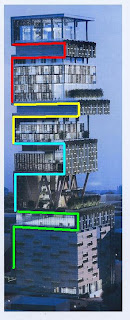


I am also deeply concerned with unemployment in India and I have started an initiative through my house that will employ 600, yes 600 people. I would like other rich to follow me in employing people in this manner.

Me – Mukesh is there any advice you would like to give?

Mukesh (with great emotion) – My life is my message; I can’t leave behind anything for future generations because I plan to leave everything for my children.

Its already 4 am and Mukesh wants to get back to sleep, I thank him for his magnanimity in speaking to lil-ol-me, his kindness for not screaming, his generosity in spending a few hours in an interview.

My meeting Mukesh is wishful thinking.